

















Navigating The New Perimeter
FEATURED May, 2026

Navigating The New Perimeter

We have officially entered the era of the reasoning agent.

Agentjacking Explained
FEATURED Jul, 2026

Agentjacking Explained

A new attack vector called Agentjacking has demonstrated that you do not need to trick the developer. You only need to trick the tool the developer trusts.

Auditing Reasoning Agents
FEATURED Jun, 2026

Auditing Reasoning Agents

We have officially entered the era of the opaque agent. When an AI agent misbehaves in production, your standard infrastructure logs look flawless. In an era where agents make decisions, we need more than execution traces.

How Old Is Your Model's Data?
FEATURED 15 Jun 2026

How Old Is Your Model's Data?

How up to date is your model really? I went straight to the source to ask each of the models when they were last updated, and the results were surprising.

9 Seconds of PocketOS Rewritten
FEATURED 17 May, 2026

9 Seconds of PocketOS Rewritten

We have all heard the horror story about what happened with PocketOS. We show you how those 9 seconds could have gone differently.

How Hot Is Your AI?
AI 30 Mar, 2026

How Hot Is Your AI?

As a heavy AI user, I like to experiment with different models, and the results have been wildly varied. Some give me consistent results, time after time. Others are largely unpredictable.

What Does Your AI Know About You?
SECURITY 21 Mar, 2026

What Does Your AI Know About You?

As we move from simple chatbots to autonomous agents, our security paradigm must shift. The firewall is no longer the only perimeter. The new perimeter is your prompt.

The AI Slop Tsunami: Technical Debt in the Age of Autocomplete
TECHNICAL DEBT 27 Oct, 2025

The AI Slop Tsunami: Technical Debt in the Age of Autocomplete

The real metric isn't output velocity; it's outcome velocity. And right now, they are moving in opposite directions.

5 Core Components of a Software Application
SOFTWARE ARCHITECTURE 26 Feb, 2024

5 Core Components of a Software Application

To enforce code quality and consistency, many companies use templates or automated tools, such as archetypes, scaffolders or smart projects to extend the standard directory layout. This article takes a deep dive into five of the core components of a software application.

Avoiding Technical Debt with the Rise of Automation
TECHNICAL DEBT 21 Sep, 2023

Avoiding Technical Debt with the Rise of Automation

Automation has become a critical component of software development, driving down costs and improving readiness to respond to the constant changes in business and technology. However, with all the promise of automation are we at risk of accumulating a higher level of technical debt?

Navigating The New Perimeter
SECURITY May, 2026

Navigating The New Perimeter

We have officially entered the era of the reasoning agent. Models like Anthropic's Computer Use and the emerging capabilities of autonomous workflows have crossed a threshold: they can navigate unfamiliar interfaces, interpret visual feedback, and execute multi-step plans without hardcoded paths.

The Mechanics of Hot AI
CONFIGURATION Apr, 2026

The Mechanics of Hot AI

We have officially moved past the era of treating LLMs as magical black boxes. The engineering discipline around AI is maturing, and with it, an understanding that the same model can be wildly creative or rigidly deterministic depending on a handful of settings.

Getting Ready for Q-Day
QUANTUM COMPUTING Mar, 2026

Getting Ready for Q-Day

We have officially moved past the theory phase. NIST has finalized its first three post-quantum cryptography standards (FIPS 203, 204, and 205), replacing the RSA and ECC algorithms that have underpinned digital trust for decades.

Transitioning To AI Augmented APIs
SOFTWARE ARCHITECTURE Feb, 2026

Transitioning To AI Augmented APIs

Simply exposing existing APIs to this new intelligence is a path to fragile systems. The patterns built for human developers, with their tolerance for nuance and ability to consult documentation, become sources of hallucination and error for AI.

Understanding Your Dev Tools
DEVELOPMENT Dec, 2025

Understanding Your Dev Tools

Too often, development tools are chosen for velocity alone, with security treated as a separate concern for later review. The reality is that the tools themselves can become the vulnerability.

Coding With Confidence
SOFTWARE ARCHITECTURE Nov, 2025

Coding With Confidence

Too often, AI integration is focused solely on the speed of creation, while the long-term cost of maintenance is treated as a problem for later. The reality is that without deliberate guardrails, AI-generated code can silently institutionalize complexity, embedding subtle anti-patterns and unoptimized logic at scale.

Building Trust for API Monetization
SECURITY Oct, 2025

Building Trust for API Monetization

It's not just about publishing APIs, it's about publishing APIs that are secure, reliable, and fraud-resistant from day one.

Coding For Operations
DEVELOPMENT Sept, 2025

Coding For Operations

For too long, logging and operational design have been treated as an afterthought, something bolted on late in the process. But as systems grow more interconnected and the cost of downtime rises, structured, consistent logging is becoming a critical part of delivery.

Back to Home

Coding For Operations

Welcome to Smart Code News. This month, we're talking about coding for operations, specifically, why designing with observability in mind is no longer optional. Across the industry, development teams are expected not only to deliver integrations quickly, but also to ensure they can be monitored, supported, and scaled once they're in production.

For too long, logging and operational design have been treated as an afterthought, something bolted on late in the process. But as systems grow more interconnected and the cost of downtime rises, structured, consistent logging is becoming a critical part of delivery. Without it, even small incidents can turn into prolonged outages, with teams scrambling to trace issues across multiple services.

That's why we're shifting the conversation. It's not just about building integrations that work, it's about building integrations that can be operated with confidence. This month, we're exploring how thoughtful logging and operational design can transform your APIs from black boxes into transparent, diagnosable services.

Logging Left Behind

We once worked with a company where a structured logging strategy was recommended early in the project. It was designed to make support and monitoring straightforward, but the decision was made to move forward without it, out of concern that it would slow delivery and add unnecessary overhead.

The project advanced all the way to UAT, where an issue surfaced. When the team tried to troubleshoot, they quickly realized the problem: the logs provided no meaningful information. Without visibility, identifying the root cause was guesswork.

In the end, every API had to be refactored to include logging, an expensive and time-consuming exercise that could have been avoided. It was a lesson learned the hard way: when logging isn't designed in from the start, the cost of adding it later multiplies.

Meaningful Logging

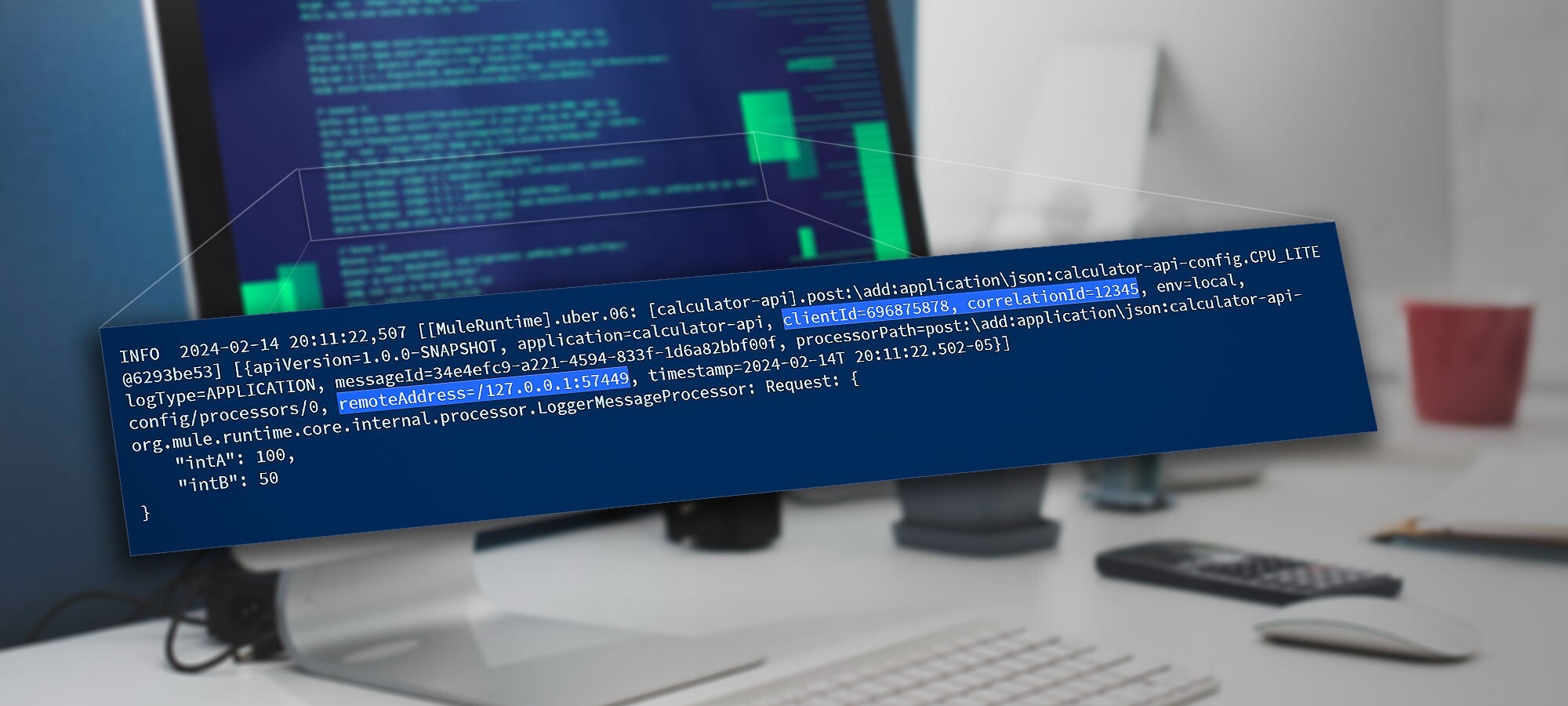
Good logging isn't about volume, it's about structure. The most effective logs capture information in key-value pairs, giving every entry a clear, machine-readable format. Instead of just long strings of text, each log line is prefixed with structured data that can be indexed, searched, and correlated across services.

When logs follow this pattern, modern log management tools can do the heavy lifting, indexing fields automatically and enabling powerful search filters. Need to find every error tied to a specific user, request, or service? A structured log makes it possible in seconds. Without this level of consistency, log analysis becomes manual and error-prone, slowing down operations when speed matters most.

Meaningful logging turns your APIs from opaque black boxes into transparent systems that can be monitored and diagnosed with confidence.

Log Filtering

To make logs truly useful, they need to be designed for filtering. By including the right identifiers in every log entry, teams can quickly narrow down the search and focus on exactly what matters. Here are a few of the most common filters to build in:

Correlation ID

This allows operations to search the logs for a specific business process or transaction, by associating a unique identifier to every layer of the request for each application or API in the service call.

Message ID

This allows operations to drill in on a specific set of messages within the same application or API, allowing them to narrow their focus to a specific area of interest.

Client ID

This allows operations to track requests from a specific client. A client is a system, not a user that registers to use an API. During registration, the client receives a unique identifier, which makes it possible to monitor its traffic and usage patterns.

API Version

This allows operations to distinguish between versions that are running in parallel in production. By logging the version number, issues can be tied back to the correct release, making it clear whether an error is a new defect or one already fixed in the next version.

Log Masking

Designing for operations isn't just about what gets logged, it's also about what doesn't. APIs often process sensitive data such as account numbers, personal details, or credentials, and without proper safeguards this information can end up exposed in logs. That creates both a security risk and a compliance issue.

Log masking provides a controlled way to balance visibility with protection. Instead of writing sensitive values directly to logs, fields are masked or obfuscated, giving operations teams enough information to troubleshoot without exposing raw data. For example, an account number might be partially masked, showing only the last few digits to confirm context while hiding the rest.

The key is consistency. By defining which fields must always be masked and building that logic into the logging framework, teams can ensure sensitive information is protected across every API and environment. With this in place, logs remain a valuable tool for monitoring and support without introducing unnecessary risk.

When logging is designed as a first-class concern, not an afterthought, it transforms operational readiness. Teams gain the visibility they need to diagnose issues quickly, monitor system health proactively, and build confidence in their production environment.

This is the foundation of operational excellence: systems that are not just built to work, but built to be observed, understood, and supported at scale.